

Sheffield City Council’s (SCC) Upper Don Valley (UDV) proposal covers Langsett Road, Middlewood Road and Holme Lane.
These roads are key arterial routes for cycling in Sheffield, but they also contain on-road tram tracks. Tram tracks are one of the greatest hazards facing people cycling in Sheffield. Analysis by CycleSheffield indicates that reported cycling injuries on roads with tram tracks occur at a rate per kilometre more than 50 times that recorded across Sheffield’s wider highway network.[1]
Since 2015 there have been 416 reported cycle–tram track crashes within the UDV scheme boundary. Of these, 103 resulted in serious injury, 289 in slight injury and 24 resulted in no reported injury. 46% of all reported cycle–tram track crashes in Sheffield have occurred within the UDV scheme boundary.
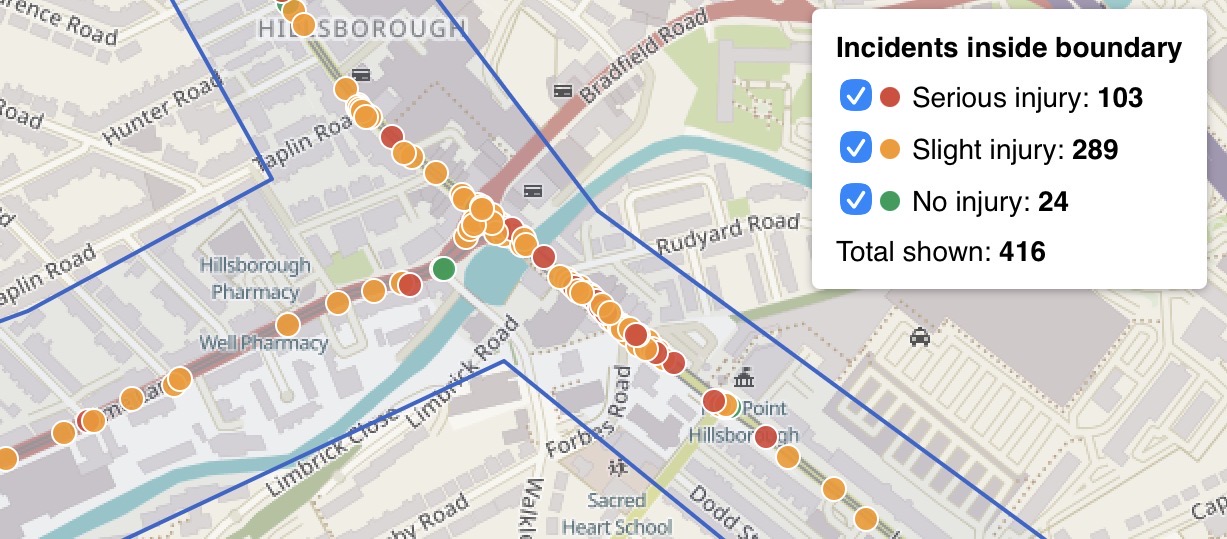
The principal crash hotspots are:
- Primrose Hill tram stop
- Bamforth Street tram stop
- Hillsborough tram stop
- Hillsborough Corner
- Hillsborough Park tram stop
- Leppings Lane tram stop
- Holme Lane/Loxley New Road junction
These crashes are concentrated at identifiable locations where the road layout and tram-track configuration create hazards for people cycling. These are not unforeseeable problems: SCC has had access to evidence of these dangers for years and has identified these locations as requiring intervention.
No other group of road users — whether walking, wheeling, driving, travelling as a passenger in a private car or taxi, or using public transport — have a comparable concentration of reported injuries on Langsett Road, Middlewood Road and Holme Lane. Between 2015 and 2025, CrashMap records 114 police-reported collisions resulting in casualties on Langsett Road, Middlewood Road and Holme Lane. Over the same period, CycleSheffield has received reports of 416 cycle–tram track crashes on these roads. Although the figures come from different reporting systems, the scale of the reported cycle–tram track problem is striking.
Three of the five worst locations in Sheffield for tram-track crashes are within the scheme boundary: Langsett Road at Primrose Hill tram stop, the Holme Lane/Loxley New Road junction, and Hillsborough Corner.
SCC’s 2016 Tram / Cycle Safety Action Plan set out clear commitments to address this problem. These included developing design solutions for the five worst crash locations by March 2017, completing their implementation by September 2017, developing solutions for different types of tram-track interface, and implementing improvements at the 20 worst locations during 2017/18 and 2018/19.
These commitments were made almost a decade ago. Yet the dangerous locations identified in the plan remain and the promised programme of improvements has not been delivered. Whilst responsibility for the tram network itself lies with SYMCA, SCC remains responsible for the wider highway network. Section 39 of the Road Traffic Act 1988 requires local authorities to investigate road accidents and take measures that appear appropriate to prevent them. Given the longstanding evidence of cycle–tram track crashes, and the identification of dangerous locations in SCC’s own action plan, the absence of any proposed cycling safety improvements raises serious questions about the council’s approach to discharging these responsibilities.
SCC’s Walking, Wheeling and Cycling Investment Plan, published in April 2025, identifies future and priority cycle network links connecting Hillsborough with Malin Bridge and Middlewood on its cycle strategy map (page 42). Meanwhile, SCC’s Road Safety Action Plan 2024–2029 states that it sets out how the council will “make Sheffield roads safer for everyone”.
Yet, despite these stated ambitions, the documented dangers posed by tram tracks and the council’s previous commitments to address the worst locations, the UDV proposals include no improvements for people cycling. The scheme therefore misses an opportunity both to address longstanding safety problems and to deliver planned cycle network connections. This is a stark contradiction between SCC’s stated commitments and its actions.
This is an unacceptable omission. The UDV scheme is an opportunity to address longstanding, documented safety problems and deliver the cycle network connections identified in SCC’s own investment plan. Instead, it perpetuates the failure to translate the council’s stated commitments into action.
Given the limited funding available for transport in the UK and the slow pace at which major transport schemes are delivered by SCC, there is a real risk that opportunities to improve cycling infrastructure in the UDV area will be missed for another 10–20 years.
More than three decades after the Supertram network began operating, SCC has failed to deliver an adequate, systematic programme of safety improvements for people cycling around the tram network.
SCC’s sustained failure to address cycling safety around the tram network is grotesque. It undermines any claim that the council is serious about reducing serious injury and death or increasing cycling in Sheffield. A scheme covering some of the city’s most hazardous routes for cycling should be an opportunity to address these dangers, not another missed opportunity to do so.
References
[1] Between 2015 and 2023, CycleSheffield received reports through TramCrash.co.uk of 636 cycling injuries on roads with tram tracks, which extend for approximately 18.5 km across Sheffield — just under 1% of the city’s highway network. For comparison, police data recorded 1,172 cycling injuries from all causes across Sheffield during the same period. This indicative comparison suggests that reported cycling injuries on roads with tram tracks occur at a disproportionately high rate per kilometre. The datasets use different reporting systems, however, so the figure of more than 50 times should be understood as an indication of the scale of the problem, rather than a definitive measure of relative risk.
SCC Road Safety Action Plan for Vision Zero 2025
SCC Tram / Cycle Safety Action Plan 2016
Tram/ Cycle infrastructure Review Study 2016
SCC Investigation into cyclist safety on the Supertram network in Sheffield 1998
